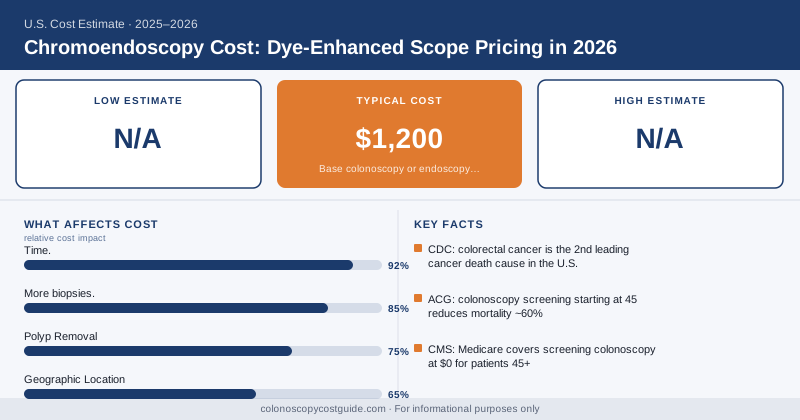
Chromoendoscopy Cost: Dye-Enhanced Scope Pricing in 2026
{ if eq .Lang "zh" }{ else }{ end }Imagine spraying a blue dye onto the lining of your colon so subtle, flat lesions light up like writing under a blacklight. That’s chromoendoscopy, and patients are often surprised it adds only a modest amount to the procedure bill — usually $150 to $600 over a standard scope.
It’s a technique, not a separate machine. During an endoscopy or colonoscopy, the doctor sprays a contrast dye (commonly methylene blue or indigo carmine) through the scope to highlight tissue patterns the naked eye misses. The dye is cheap; the value is in catching what a plain exam would skip.
What Chromoendoscopy Costs
Because chromoendoscopy piggybacks on a base procedure, the real number is the scope cost plus the dye-and-time add-on. Here’s how it shakes out.
| Cost Component | Typical Range (Uninsured) |
|---|---|
| Base colonoscopy or endoscopy facility fee | $1,200 – $4,000 |
| Chromoendoscopy dye and added technique | $150 – $600 |
| Gastroenterologist time premium | $0 – $400 |
| Pathology (per biopsy/lesion) | $200 – $800 |
| Total estimate | $1,500 – $5,000 |
For context, a standard colonoscopy without the dye runs in roughly the same ballpark before the add-on. The dye itself costs the facility only a few dollars — most of the premium is the extra 10 to 20 minutes of careful inspection.
Why It Costs Extra (When It Does)
Often the dye is bundled into the base procedure code and you won’t see a separate line item. When a premium does appear, it reflects two things:
- Time. Spraying, washing, and re-inspecting the mucosa adds meaningful minutes, and endoscopy suites bill by the slot.
- More biopsies. Chromoendoscopy frequently uncovers lesions that wouldn’t have been seen otherwise, and each one sent to pathology adds $200–$800. That’s a cost of doing the job well, not a markup.
If you want the bigger picture on why scope-based procedures carry the prices they do, why is colonoscopy so expensive breaks down the facility and sedation drivers.
Who Actually Benefits
This is a targeted tool, not a routine upgrade. The American College of Gastroenterology recommends dye-spray chromoendoscopy for surveillance in patients with long-standing inflammatory bowel disease, where flat dysplasia is easy to miss. The CDC reports that ulcerative colitis and Crohn’s affect roughly 3 million U.S. adults — a meaningful pool of people who benefit from sharper surveillance.
It’s also used in Barrett’s esophagus surveillance, Lynch syndrome screening, and hunting down flat colorectal lesions. For an average-risk 50-year-old getting a first screening, a modern high-definition scope generally does the job without dye.
Key Takeaway
Insurance Coverage
When chromoendoscopy is done for an accepted indication — IBD surveillance, Barrett’s, Lynch syndrome — coverage mirrors the underlying scope. Because the dye is often not separately coded, you rarely see a standalone “chromoendoscopy charge” on your statement.
The catch is the same one that trips up a lot of colon screening: if the doctor finds and removes a lesion, a screening exam can be reclassified as diagnostic, which may shift cost-sharing to you. This is the same reason colon polyp removal sometimes generates a surprise bill after a “free” screening.
How It Compares to Other Enhancement Techniques
Chromoendoscopy competes with electronic chromoendoscopy — narrow-band imaging and similar built-in light filters that don’t require dye. Those are essentially free because they’re a button on the scope, but for IBD surveillance, dye-spray still has the strongest evidence behind it. If a lesion turns up that needs deeper evaluation, your doctor may follow with an endoscopic ultrasound or a targeted endoscopy biopsy.
Bottom Line
Chromoendoscopy is one of the better deals in GI: a small premium that materially improves lesion detection for the right patient. Uninsured, you’re looking at $1,500–$5,000 all-in, with the dye component adding only $150–$600. If you have IBD or a hereditary cancer risk, ask whether dye-spray surveillance makes sense — it’s frequently covered and could catch something a plain scope would miss. If you’re average-risk, save your money for the standard exam.
{ if eq .Lang "zh" }