Cologuard Cost: Price, Insurance Coverage, and What Happens If It's Positive
{ if eq .Lang "zh" }{ else }{ end }Cologuard’s list price is $649. You’ve probably seen the commercials. Here’s what it actually costs — and what the commercials don’t mention: a positive result means you’re getting a colonoscopy anyway, and that one isn’t free.
What Cologuard Is (and Isn’t)
Cologuard is a stool DNA test made by Exact Sciences. It detects certain DNA mutations and blood in stool that can indicate colorectal cancer or large precancerous polyps. You collect a stool sample at home and mail it to a lab — no bowel prep, no sedation, no procedure facility.
The FDA approved Cologuard in 2014. The USPSTF includes it as an acceptable colorectal cancer screening option (updated 2021 recommendations). The test has:
- Sensitivity for colorectal cancer: ~92% (detects cancer when it’s there)
- Specificity: ~87% (correctly identifies negative results)
- False positive rate: approximately 13% — meaning about 1 in 7 people with no cancer will get a positive result and be sent for colonoscopy
That false positive rate is the number the commercials skip. It drives a meaningful portion of Cologuard’s “hidden cost” — the follow-up colonoscopy that a positive result requires.
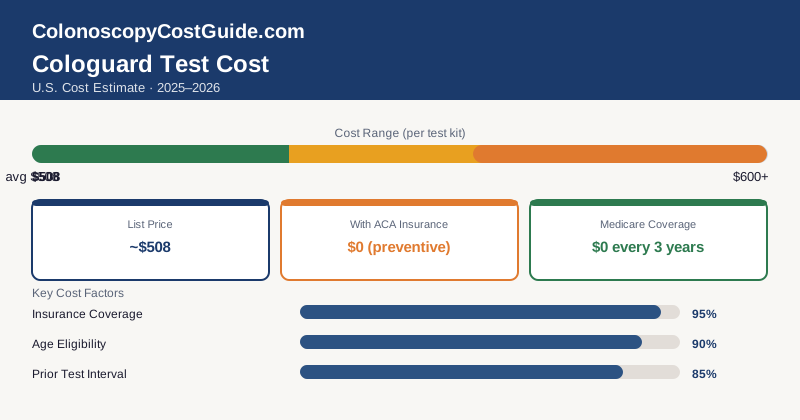
Cologuard List Price: $649
Without insurance, Cologuard costs $649 — the price Exact Sciences charges labs that process and bill for the test. This is not negotiable with GoodRx or with the facility; it’s a proprietary test billed by a single company.
Some cost-reduction options for uninsured patients:
- Exact Sciences Patient Assistance Program: Exact Sciences offers a patient assistance program for uninsured patients below income thresholds. The test may be available at $0 or reduced cost. Call 1-844-870-8870 to ask about eligibility.
- FQHC referral: Some FQHCs have negotiated rates with Exact Sciences for their patient population
Insurance Coverage for Cologuard
Medicare Part B Coverage
Medicare Part B covers Cologuard at zero cost-sharing for Medicare beneficiaries who are:
- Between age 50 and 85 (Medicare uses age 50 as the Cologuard coverage start)
- Asymptomatic (no symptoms suggesting colorectal cancer)
- Average risk (no personal or family history of colorectal cancer)
- Have not had a Cologuard test in the past 3 years
Medicare’s covered frequency for Cologuard is every 3 years. The test is billed under HCPCS code G0464 and is covered at $0 — no deductible, no Part B coinsurance.
Important: if you’re under 50 on Medicare, coverage may not apply. And if you’ve had a colonoscopy recently, Medicare may question the frequency of screening.
Commercial Insurance Coverage
Most ACA-compliant commercial insurance plans cover Cologuard as a preventive service. The USPSTF recommendation (Grade B) for Cologuard as a colorectal cancer screening option triggers the ACA preventive care mandate for plans subject to Section 2713.
Typical commercial insurance coverage:
- $0 cost-sharing on most ACA-compliant plans for average-risk patients on the covered screening schedule
- Covered frequency: Most commercial plans follow a 3-year interval
- Exceptions: Some plans treat Cologuard as a diagnostic test (not preventive) and apply cost-sharing — this is increasingly rare but worth verifying
| Insurance Type | Cologuard Cost to Patient | Covered Frequency |
|---|---|---|
| Medicare Part B | $0 | Every 3 years |
| ACA commercial plan | $0 (most plans) | Every 3 years |
| Medicare Advantage | $0 (most plans, check EOC) | Every 3 years |
| Medicaid | Varies by state; generally $0 | Varies |
| Uninsured | $649 list price | N/A |
| Exact Sciences assistance program | $0 (income-eligible) | N/A |
What Happens If Your Cologuard Is Positive
A positive Cologuard result means you need a colonoscopy. Not eventually — soon.
Here’s the critical insurance issue: a follow-up colonoscopy after a positive Cologuard is diagnostic, not screening. Your insurer codes it as a diagnostic procedure (CPT 45378 with a finding code, not a screening Z-code). That means:
- It’s not covered as a preventive service at $0
- It’s subject to your deductible and coinsurance
- If you haven’t met your deductible, you could owe $800–$2,000 for the follow-up colonoscopy
This is the most significant hidden cost in the Cologuard vs. colonoscopy comparison. A $0 Cologuard test can lead directly to a $1,200 diagnostic colonoscopy. See Cologuard vs. colonoscopy cost for the full 10-year comparison.
Before You Order Cologuard: Questions to Ask Your Doctor
- “If Cologuard is positive, how will my insurance cover the follow-up colonoscopy? Will it be treated as diagnostic?”
- “Do I have any risk factors that would make colonoscopy more appropriate as my first-line screening?”
- “What is my insurer’s covered frequency for Cologuard, and how does it compare to colonoscopy?”
Some patients are better served by colonoscopy as first-line screening — particularly those with family history, prior polyps, or who are comfortable with the procedure. Others genuinely prefer Cologuard’s non-invasive approach. Make the decision with full information about the cost implications of a positive result.
Cologuard After Negative Colonoscopy
If you’ve recently had a clean colonoscopy, you don’t need Cologuard — and your insurer won’t cover it. The two tests aren’t used simultaneously or in close succession. They’re alternative screening strategies with different intervals and cost structures.
For a complete comparison of the long-term costs of Cologuard vs. colonoscopy screening strategies, see Cologuard vs. colonoscopy cost.
{ if eq .Lang "zh" }