Cologuard vs. Colonoscopy Cost: 10-Year Total Cost Comparison
{ if eq .Lang "zh" }{ else }{ end }The $0 Cologuard test seems cheaper than a $0 colonoscopy until you factor in a 13% false positive rate, a diagnostic follow-up that hits your deductible, and the fact that you’re doing it three times per decade instead of once.
Here’s the real 10-year cost comparison — insured and uninsured — with the follow-up colonoscopy math included.
The Basic Parameters
Colonoscopy: Performed every 10 years for average-risk adults. One procedure per decade. If no polyps are found, next colonoscopy is 10 years later.
Cologuard: Recommended every 3 years by the USPSTF for average-risk adults who choose stool DNA testing. Three tests per 10-year period. If the result is positive, a diagnostic follow-up colonoscopy is required — and that colonoscopy starts the 10-year surveillance clock if normal, or changes the schedule if polyps are found.
The False Positive Factor
Cologuard’s clinical trials showed a false positive rate of approximately 13% — about 1 in 7.5 people with no cancer will test positive and undergo a diagnostic colonoscopy unnecessarily. That diagnostic colonoscopy:
- Is coded as diagnostic, not preventive
- Doesn’t get ACA zero-cost-sharing protection
- Hits your deductible
- Adds $800–$2,000 to your out-of-pocket depending on your plan
Over a 10-year period with 3 Cologuard tests, the probability of at least one false positive is approximately 34% (1 - 0.87³). More than 1 in 3 people using Cologuard for a decade will get at least one false positive and need a diagnostic colonoscopy.
10-Year Cost Comparison: Insured Patient (ACA Plan, $1,500 Deductible)
Colonoscopy Strategy (1 procedure in 10 years):
- 1 screening colonoscopy: $0 (ACA preventive)
- 10-year total: $0 (assuming no polyps found)
- If polyps found and reclassified as diagnostic: $0–$600 depending on insurer policy
Cologuard Strategy (3 tests in 10 years):
- 3 Cologuard tests: $0 each (ACA preventive)
- No false positive (73% probability): $0 total
- One false positive (34% probability): $0 Cologuard + $1,200–$2,000 diagnostic colonoscopy = $1,200–$2,000
Expected 10-year cost for Cologuard (factoring in false positive probability):
- 0.73 × $0 + 0.27 × (weighted cost of false positive + follow-up colonoscopy) ≈ $300–$700 expected
| Strategy | Tests Per 10 Years | Base Cost (All $0 Coverage) | Expected 10-Year Cost (With False Positive Probability) |
|---|---|---|---|
| Colonoscopy (no polyps) | 1 | $0 | $0 |
| Colonoscopy (polyp found, preventive coding honored) | 1 | $0 | $0 |
| Colonoscopy (polyp found, diagnostic reclassification) | 1 | $0 – $600 | $100 – $200 (15% probability × cost) |
| Cologuard only (no positive results) | 3 | $0 | $0 |
| Cologuard + 1 false positive follow-up colonoscopy | 3 + 1 | $0 + $1,200–$2,000 | $300 – $700 (34% probability × cost) |
10-Year Cost Comparison: Uninsured Patient
For cash-pay patients, the math changes significantly:
Colonoscopy Strategy:
- 1 colonoscopy at a freestanding ASC: $900–$1,500 (cash-pay, negotiated)
- 10-year total: $900–$1,500 for the decade
Cologuard Strategy:
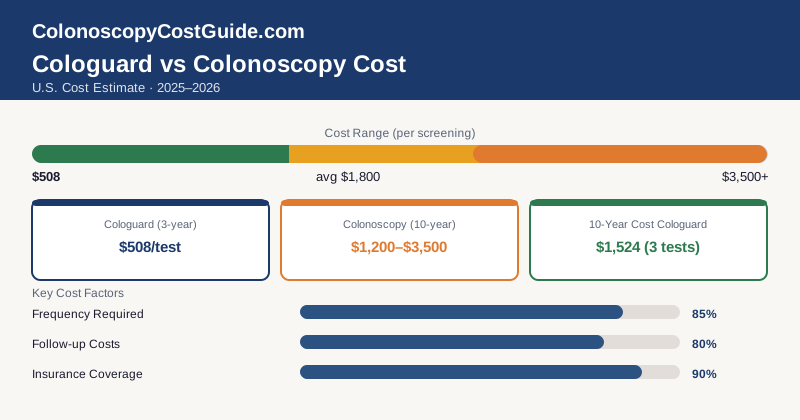
- 3 Cologuard tests × $649: $1,947
- If 1 false positive (34% probability), add 1 diagnostic colonoscopy: $900–$1,500
- Total with false positive: $2,847–$3,447
- Expected 10-year cost: $1,947 + (0.34 × $1,200) = ~$2,355
For uninsured patients, colonoscopy is dramatically cheaper over 10 years: $900–$1,500 vs. an expected $2,000–$2,400 for Cologuard.
The Key Non-Cost Difference: Sensitivity and Polyp Detection
Cost isn’t the only comparison metric. Colonoscopy detects and removes precancerous polyps in the same procedure. Cologuard detects the DNA signatures of cancer and large polyps — but it doesn’t remove them.
Colonoscopy’s adenoma detection rate (ADR) is the critical quality metric. A high-quality colonoscopy performed by an experienced gastroenterologist misses fewer than 5–10% of significant adenomas. Cologuard detects approximately 42% of advanced precancerous adenomas — meaning it misses about 58%.
For patients who cannot safely undergo colonoscopy (serious comorbidities, anticoagulation issues) or who strongly prefer non-invasive options, Cologuard is a meaningful alternative. For average-risk patients without those considerations, colonoscopy provides more complete detection and removes what it finds.
After a Positive Cologuard: The Cost Cascade
If your Cologuard is positive — whether true positive (cancer or polyp) or false positive (nothing found):
- You need a diagnostic colonoscopy — coded with a positive finding, not screening
- That colonoscopy is subject to your deductible and coinsurance
- If the colonoscopy finds nothing (false positive), you’ve paid deductible costs + the $0 Cologuard cost
- If the colonoscopy finds a polyp, you pay deductible + coinsurance + possible pathology costs
- Your next colonoscopy is scheduled based on what was found — typically in 3–5 years for small polyps, which resets the surveillance clock more frequently than the 10-year colonoscopy screening interval
For patients who get a positive Cologuard and find nothing on follow-up, they’re essentially back to square one — and have now spent $1,500+ on a test sequence that confirmed they were fine.
Who Benefits Most From Each Strategy
Colonoscopy is likely the better choice when:
- You’re uninsured or have a high deductible that will be hit by follow-up
- You’re comfortable with the procedure and sedation
- You want direct polyp removal (no separate diagnostic procedure if something is found)
- Your insurer has favorable polyp billing policies (polypectomy during screening covered at $0)
Cologuard may be the better choice when:
- You have significant medical comorbidities making colonoscopy higher risk
- You strongly prefer non-invasive testing and the follow-up risk is acceptable
- You have good insurance with low deductibles (minimizing the false positive colonoscopy cost)
- Your doctor recommends it based on your clinical situation
For details on Cologuard pricing and insurance coverage, see Cologuard cost. For the full picture of colonoscopy costs, see colonoscopy cost.
{ if eq .Lang "zh" }