Colonoscopy Cost With a High-Deductible Health Plan: Math, Strategy, and HSA Timing
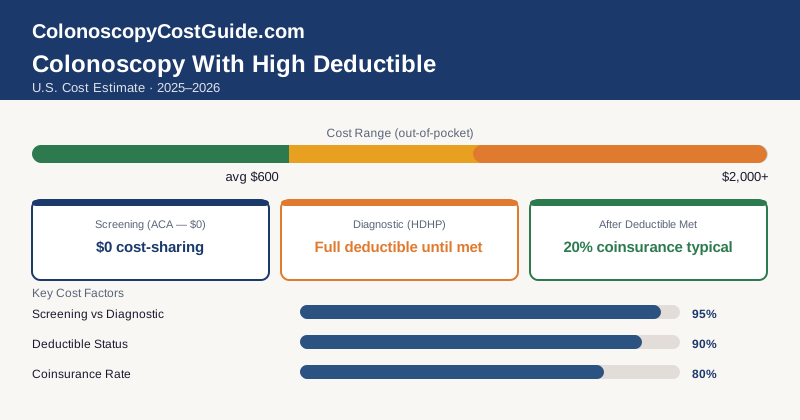
{ if eq .Lang "zh" }{ else }{ end }Here’s the math that surprises HDHP plan members every year: a colonoscopy in January costs $0. The same procedure — same doctor, same codes — can cost $1,400 in February if you have a $1,500 deductible and your GI physician finds a polyp.
That’s not a billing error. That’s HDHP design working exactly as intended. Here’s how to understand it and use it to your advantage.
Preventive Colonoscopy on an HDHP: Still $0
This is the part that confuses people. HDHPs have high deductibles — often $1,500 to $3,000 for individuals, sometimes $4,000+ for families. But federal law (and IRS guidance) specifically exempts preventive care from deductibles, even on HDHPs.
A properly coded preventive screening colonoscopy is covered at $0 on your HDHP — before your deductible is met, period. If you’re average-risk, 45 or older, and your colonoscopy is coded as CPT 45378 with a Z-code screening diagnosis, your HDHP must cover it at zero cost-sharing.
The IRS confirmed this in Notice 2004-23 and subsequent guidance: HDHPs can cover preventive services (as defined by the USPSTF, ACA, and other authorities) without cost-sharing, without affecting the plan’s status as an HDHP, and without affecting your HSA eligibility.
When the Deductible Does Apply: Diagnostic Colonoscopies
The deductible kicks in when your colonoscopy is coded as diagnostic. That happens when:
- You have symptoms (rectal bleeding, changes in bowel habits, abdominal pain)
- Your doctor finds and removes a polyp during a screening exam and the insurer reclassifies the visit
- You’re getting a follow-up colonoscopy after a positive Cologuard test
- You have a personal or family history that triggers a diagnostic rather than screening indication
On a $1,500 individual deductible HDHP, a diagnostic colonoscopy at an in-network ASC might have a total allowed amount of $1,800 (facility + physician + anesthesia). If you haven’t met any of your deductible yet, you owe $1,500 (the deductible), then 20% coinsurance on the remaining $300 = $60. Total: $1,560.
The same procedure at a hospital HOPD might have a total allowed amount of $3,200. You’d owe $1,500 (deductible) + 20% of $1,700 = $340. Total: $1,840.
| Scenario | HDHP Deductible | Total Allowed Amount | Patient Owes |
|---|---|---|---|
| Preventive screening, no polyps | $1,500 | $1,400 | $0 (exempt from deductible) |
| Diagnostic, deductible unmet | $1,500 | $1,800 (ASC) | ~$1,560 |
| Diagnostic, deductible half-met | $1,500 ($750 remaining) | $1,800 (ASC) | ~$810 |
| Diagnostic, deductible fully met | $1,500 | $1,800 (ASC) | ~$300 (20% coinsurance) |
| Preventive with polypectomy (insurer honors preventive coding) | $1,500 | $2,200 | $0 |
| Preventive with polypectomy (insurer recodes as diagnostic) | $1,500 | $2,200 | ~$1,560 |
The Timing Strategy: When to Schedule
If your colonoscopy could be coded diagnostically (you have any risk factors, prior polyps, or symptoms), timing your procedure strategically can save hundreds of dollars.
Scenario: Your individual deductible is $1,500. By October, you’ve paid $1,200 in other medical expenses this year. That means only $300 of deductible remains. A diagnostic colonoscopy in October costs you $300 deductible + 20% coinsurance on any amount above that. The same procedure in January would cost the full $1,500+ deductible.
The math: Schedule in October, pay $300 + $60 coinsurance on a $1,800 colonoscopy = $360 total. Schedule in January, pay $1,500 + $60 = $1,560 total. Difference: $1,200 in out-of-pocket savings just from timing.
The key caveat: don’t delay a medically necessary colonoscopy for 9 months just to hit deductible timing. If you have symptoms or your doctor wants the procedure done promptly, do it promptly. This strategy applies to elective scheduling of routine surveillance colonoscopies where you have genuine flexibility.
Calculating the Right Timing Window
To find your optimal scheduling window:
- Call your insurer and ask: “What is my current year-to-date deductible balance? How much do I have remaining?”
- Estimate your expected medical spending for the rest of the year
- If you expect to hit your deductible through other expenses (other planned procedures, prescriptions, ongoing care), schedule your colonoscopy after that threshold is crossed
- Use your HSA to cover any deductible amounts you do owe — all colonoscopy costs are HSA-eligible
This strategy works best for people with chronic conditions, multiple prescriptions, or other planned procedures that are drawing down the deductible through the year.
HSA as the Missing Piece
The HDHP + HSA combination is designed so that the HSA covers deductible costs tax-free. For colonoscopy, this means:
- A preventive screening costs $0 (no HSA needed)
- A diagnostic colonoscopy hits your deductible — pay it from HSA with pre-tax dollars
- The 22% (or more) tax savings on HSA withdrawals lowers your real out-of-pocket by that percentage
- Your HSA can cover facility fees, anesthesia, pathology, and even prep medications
An HDHP member in the 24% federal tax bracket paying $1,200 out-of-pocket for a diagnostic colonoscopy pays $912 in real dollars when using HSA funds. That’s a $288 tax benefit built into the account design.
The Polyp Risk: How a Screening Can Hit Your Deductible
This is where HDHP members get blindsided. You schedule a preventive screening. You’re confident it’ll be $0. Your doctor finds a small polyp and removes it in the same procedure. Your insurer reclassifies the encounter as diagnostic.
Now you’re facing $1,000–$1,500 in deductible costs you didn’t budget for.
Protect yourself:
- Call your insurer before the procedure: “If a polyp is removed, will you apply cost-sharing or treat it as preventive?”
- Understand that many major insurers (UHC, Aetna, most BCBS affiliates) now cover the polyp removal as part of the preventive encounter
- If you’re on a less common insurer or a self-funded employer plan, get the answer in writing
See the screening vs. diagnostic colonoscopy cost guide for the legal framework and what to do if you get reclassified anyway.