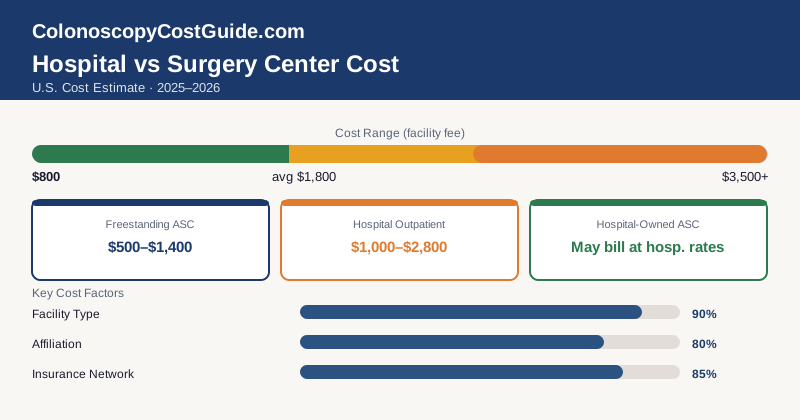
Colonoscopy Cost: Hospital vs. Ambulatory Surgery Center
{ if eq .Lang "zh" }{ else }{ end }Sarah, 52, scheduled her first colonoscopy through her GI physician’s referral. She assumed the facility was a surgery center. It wasn’t. It was a hospital outpatient department — and her bill came in at $2,400 instead of the $900 she’d seen quoted online. Same procedure. Same doctor. Different building. $1,500 difference.
The setting where your colonoscopy happens is one of the most controllable cost variables in healthcare. Here’s what drives the gap and exactly how to choose the cheaper option.
Why ASCs Cost Less Than Hospitals
Ambulatory surgery centers are dedicated outpatient facilities that do nothing but outpatient procedures. No emergency department. No ICU. No trauma unit. Lower overhead per procedure — and that savings gets reflected in the fees.
The gap isn’t small. CMS data shows that Medicare pays ASCs approximately $200 to $500 less per colonoscopy than hospital outpatient departments (HOPDs) for the exact same CPT codes. For commercial insurance, the gap is often larger — insurers negotiate different rates with hospitals than with ASCs, and hospitals’ higher list prices translate to higher allowed amounts even after contract discounts.
FAIR Health’s 2024 benchmarking data shows median commercial insurance allowed amounts for CPT 45378:
- Hospital outpatient department: $1,800 – $3,200
- Freestanding ASC: $900 – $1,600
That’s a consistent 40–55% cost difference — for the identical procedure.
| Cost Component | Hospital HOPD | Freestanding ASC |
|---|---|---|
| Facility fee (CPT 45378) | $1,200 – $2,800 | $500 – $1,400 |
| GI physician fee | $250 – $600 | $250 – $600 |
| Anesthesia fee | $500 – $1,200 | $400 – $1,000 |
| Total (no polyps) | $1,950 – $4,600 | $1,150 – $3,000 |
| Self-pay negotiated rate | $1,500 – $3,500 | $800 – $1,800 |
The Hospital-Owned ASC Trap
Here’s something most patients don’t know: not all surgery centers charge ASC rates. Many hospitals own ASCs — either on or off the main hospital campus — and bill them as hospital outpatient departments under CMS rules. That means full HOPD billing rates, even though you drove to what looks like a standalone building.
The way to tell the difference:
- Ask explicitly: “Is this a freestanding ASC or is it affiliated with a hospital system?”
- Check the facility’s CMS Certification Number (CCN). ASCs have CCN numbers ending in the 6000–6999 range. HOPDs do not.
- When calling your insurer, ask: “Is this facility billed as an ASC or as a hospital outpatient department?”
A hospital-affiliated ASC using HOPD billing can charge 2x the rate of a true freestanding ASC across the street. Same quality. Much bigger bill.
Is the Quality the Same?
Yes, for routine colonoscopy. ASCs perform millions of colonoscopies annually and are subject to the same accreditation standards (AAAHC, JCAHO, or Medicare certification) as hospital outpatient departments. The ACG and ASGE both include ASCs as appropriate settings for colonoscopy in their practice guidelines.
When would you want a hospital? If you have serious medical comorbidities — severe COPD, heart failure, morbid obesity, a history of difficult sedation — your GI physician may prefer the immediate access to hospital resources. That’s a medical decision your doctor should make. For average-risk patients scheduling routine screening or surveillance colonoscopies, a properly accredited ASC is entirely appropriate.
How to Confirm ASC Accreditation
Look for these three accreditation bodies on the ASC’s website or ask the facility directly:
- AAAHC (Accreditation Association for Ambulatory Health Care)
- The Joint Commission (TJC)
- Medicare certification (required to bill Medicare; most reputable ASCs have this)
Any of these indicates the ASC meets federal safety and quality standards. Don’t assume a nice-looking facility is accredited — ask for their accreditation number.
How to Find an In-Network Freestanding ASC
Your insurer’s online provider directory is a starting point but isn’t always accurate for facilities. The best approach:
- Ask your GI physician where they perform procedures and whether there’s a freestanding ASC option. Most gastroenterologists have hospital privileges AND an affiliated ASC.
- Use the CMS ASC locator at cms.gov/Medicare/Provider-Enrollment-and-Certification/CertificationandComplianc/ASCs to find Medicare-certified ASCs near you.
- Call your insurer with the ASC’s NPI and ask if it’s in-network and what it’s billed as (ASC vs. HOPD).
- Check the ASC’s own website — reputable facilities list their insurance contracts.
Once you identify an in-network freestanding ASC, confirm your GI physician also has privileges there (or ask for a referral to a GI physician who does).
Cost Impact on Your Out-of-Pocket
For a screening colonoscopy at zero cost-sharing, the setting doesn’t change your out-of-pocket — you pay $0 at either location if the procedure is coded correctly as preventive. The setting matters most when:
- You have a deductible that hasn’t been met (a $900 ASC allowed amount vs. $2,200 HOPD allowed amount is a $1,300 difference you might be paying yourself)
- You’re uninsured and paying cash (see colonoscopy cost without insurance for negotiation tactics)
- Your plan applies coinsurance to diagnostic colonoscopies
For uninsured patients, the ASC option is almost always the right call. For insured patients with remaining deductibles, it’s worth 20 minutes of research before scheduling.
The bottom line: the setting is your choice, not your doctor’s default. Ask the question before you schedule and you might save more than a thousand dollars without changing a single thing about the actual procedure.
{ if eq .Lang "zh" }