Colonoscopy Cost With Medicare: Screening Coverage and the Polyp Billing Trap
{ if eq .Lang "zh" }{ else }{ end }Colorectal cancer kills approximately 53,000 Americans a year, according to the CDC. A screening colonoscopy under Medicare costs you nothing — until your doctor finds a polyp. That one discovery can flip a $0 bill to a $300 charge without anyone doing anything wrong.
Here’s how Medicare colonoscopy coverage actually works, where the billing gets complicated, and what you can do about it.
Medicare Part B Screening Coverage
Medicare Part B covers two types of colonoscopy screening:
- High-risk patients: covered every 24 months. You’re considered high-risk if you have a personal or family history of colorectal cancer or polyps, or inflammatory bowel disease.
- Average-risk patients: covered every 120 months (10 years) starting at age 50 for traditional Medicare. (Note: private Medicare Advantage plans often align with the USPSTF’s updated 2021 recommendation starting at age 45 — check your specific plan.)
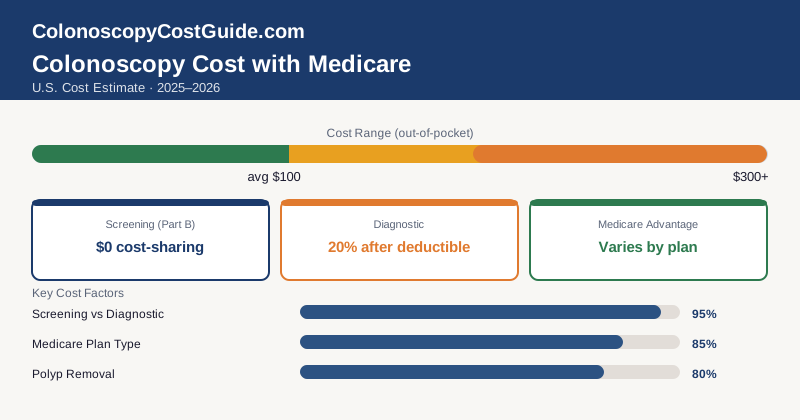
Under Medicare Part B, a screening colonoscopy is covered at zero cost-sharing. No deductible, no copay, no coinsurance — if the colonoscopy is performed at a Medicare-participating facility and by a Medicare-participating physician, and the procedure is coded correctly as screening.
Medicare pays approximately $266 for CPT 45378 (the physician fee) and a separate facility fee to the ASC or hospital outpatient department. The 2026 Medicare Physician Fee Schedule sets the national non-facility rate for 45378 at around $270 before geographic adjustments.
| Medicare Coverage Type | Your Cost (Screening, No Polyps) |
|---|---|
| Part B (screening, average-risk) | $0 |
| Part B (screening, high-risk) | $0 |
| Part B (diagnostic – with symptoms) | 20% coinsurance after deductible |
| Part A (inpatient, admitted overnight) | Part A deductible applies |
| Medicare Advantage (varies by plan) | $0 to $150+ depending on plan |
The Polyp Billing Problem
Here’s where Medicare beneficiaries get caught off guard. If your doctor removes a polyp or biopsy during what started as a screening colonoscopy, Medicare traditionally converted the billing from preventive to therapeutic. The new CPT codes — 45380 (biopsy) or 45385 (polypectomy) — triggered standard Part B cost-sharing.
For years, that meant beneficiaries owed 20% coinsurance on the allowed amount after the Part B deductible. On a $1,500 total bill, that’s $300 or more showing up weeks later.
Congress addressed this partially. Since 2020, Medicare has applied a reduced coinsurance rate for the surgical portion of a colonoscopy that begins as screening but involves a polypectomy. Under current law, the coinsurance on the therapeutic procedure is capped below the standard 20% in most cases — but it’s not eliminated entirely. The exact amount you owe depends on your plan, whether you have a Medigap supplement, and the specific procedure codes used.
How to Protect Yourself From the Polyp Billing Surprise
Before your procedure, ask your GI physician’s billing staff two questions:
- “If you find and remove a polyp, how will you code the procedure for Medicare?”
- “Will I owe cost-sharing if the procedure converts from screening to therapeutic?”
If you have a Medigap (Medicare Supplement) plan, your supplement may cover Part B coinsurance entirely — which would mean $0 even if polyps are removed. Call your Medigap insurer to confirm.
Anesthesia Under Medicare
Most Medicare-covered colonoscopies use propofol sedation administered by an anesthesiologist or CRNA. Medicare covers anesthesia under Part B, but only if you don’t have Monitored Anesthesia Care (MAC) when it isn’t medically necessary.
For routine screening colonoscopy, Medicare does cover anesthesia — but only under specific circumstances. If your GI physician determines you need deep sedation due to age, anxiety, complexity, or a long procedure, anesthesia is covered. The CRNA or anesthesiologist bills separately, and Medicare typically pays 80% of the allowed amount for anesthesia services once any applicable deductible is met.
Medicare Advantage and Colonoscopy
Medicare Advantage (Part C) plans must cover everything Original Medicare covers — but they can add their own cost-sharing structures. Many Medicare Advantage plans cover screening colonoscopy at $0 with no cost-sharing, just like Original Medicare. But some plans require:
- A prior authorization for colonoscopy (especially for non-emergency procedures)
- Use of a network facility (out-of-network facilities may have much higher cost-sharing)
- Specific referral from your primary care physician
Check your Summary of Benefits document for your Medicare Advantage plan. Look specifically at “preventive colonoscopy” and “diagnostic colonoscopy” — many plans list these separately because cost-sharing differs.
| Procedure Type | Original Medicare | Typical Medicare Advantage |
|---|---|---|
| Screening, no findings | $0 | $0 (most plans) |
| Screening with polypectomy | Reduced coinsurance (varies) | $0 to $100+ |
| Diagnostic colonoscopy | 20% after deductible | $0 to $200+ |
| Out-of-network facility | Not covered outside emergencies | Plan-specific |
Part A: If You’re Admitted as an Inpatient
The vast majority of colonoscopies are outpatient procedures billed under Part B. Part A only applies if you’re admitted to the hospital as an inpatient — which is rare for a routine colonoscopy.
If you are admitted (say, due to a complication), the Part A deductible applies: $1,676 per benefit period in 2026. This is why procedure site matters. A hospital-based colonoscopy that results in an unexpected inpatient admission can generate a much larger bill than the same procedure at a freestanding ASC.
What Medicare Doesn’t Cover
Medicare doesn’t cover colonoscopy prep medication under Part B (it’s not administered in a medical setting). Prep kits are out-of-pocket unless you have a Part D plan that covers the specific prescription. See colonoscopy prep cost for how to minimize that expense.
Medicare also doesn’t cover a screening colonoscopy more frequently than the covered interval. If you want one sooner — for peace of mind, say — you’ll pay the full cash price or your plan’s diagnostic colonoscopy rate.