Colonoscopy Cost 2026: $1,200–$4,800 (With & Without Insurance)
{ if eq .Lang "zh" }{ else }{ end }The $2,800 quote your GI office gave you is completely normal — here’s exactly what’s in it and where your money goes.
A colonoscopy isn’t a single charge. It’s three to five separate bills landing in your mailbox from different providers who were in that procedure room with you. Understanding each one is how you avoid sticker shock and catch billing errors before you pay.
What a Colonoscopy Actually Costs in 2025–2026
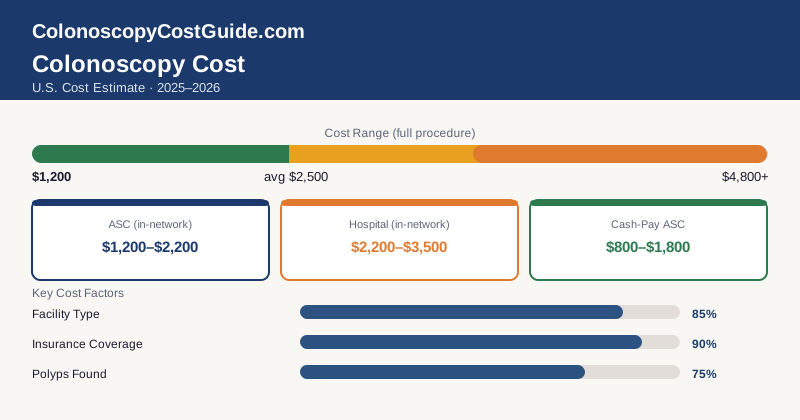
FAIR Health data puts the national median for a diagnostic colonoscopy (CPT 45378) at roughly $2,200 to $3,500 at an outpatient hospital. At an ambulatory surgery center (ASC), the same procedure runs $1,200 to $2,200. Cash-pay patients who negotiate directly often land closer to $1,000 to $1,800 at an ASC.
These numbers aren’t the price you’ll pay out of pocket — that depends on your insurance. But they’re what the system bills before any discounts or adjustments.
| Cost Component | Typical Range |
|---|---|
| Facility fee (hospital) | $1,000 – $2,800 |
| Facility fee (ASC) | $500 – $1,400 |
| Gastroenterologist fee | $250 – $600 |
| Anesthesia fee | $400 – $1,200 |
| Pathology (if biopsy taken) | $150 – $600 per specimen |
| Colonoscopy prep medication | $20 – $250 |
The Four Bills You Should Expect
1. The Facility Fee
This is usually your largest charge. It covers the procedure room, nursing staff, recovery area, equipment, and supplies. Hospitals and ASCs both charge facility fees — but hospital fees are typically 40–60% higher for the same procedure. If your doctor has privileges at both, ask which setting your procedure is scheduled at.
2. The Gastroenterologist Fee
Your GI physician bills separately from the facility. This professional fee covers their time and expertise performing the procedure. It ranges from $250 to $600 and is typically billed under CPT 45378 (diagnostic colonoscopy) or CPT 45380/45385 if polyps were removed.
3. Anesthesia
Most colonoscopies use propofol sedation, which requires a separate anesthesiologist or certified registered nurse anesthetist (CRNA). That bill runs $400 to $1,200. Conscious sedation — where the GI nurse administers the sedative — doesn’t generate a separate anesthesia bill, but not all patients are candidates.
4. Pathology
If your doctor removes a polyp or takes a tissue sample, it goes to a lab. You’ll get a pathology bill weeks later. A single specimen runs $150 to $300; multiple specimens can push $600 or more. This is where surprise bills hide.
Why Your Bill May Differ From the Estimate
Screening vs. Diagnostic: The Code That Changes Everything
There are two basic categories for colonoscopy billing:
- Screening colonoscopy (CPT G0121 or 45378 with a Z-code): performed on an average-risk patient with no symptoms. Under the ACA, this is a preventive service and must be covered at $0 cost-sharing by most insurance plans.
- Diagnostic colonoscopy (CPT 45378 with a symptom or finding): performed because of symptoms, family history, or a positive stool test. This is not automatically preventive — it’s subject to deductibles and copays.
The critical issue: if your doctor finds a polyp during a screening exam and removes it, some insurers recode the entire visit as diagnostic. The screening vs. diagnostic colonoscopy cost distinction can mean the difference between a $0 bill and a $400 bill.
Average Costs by Setting
| Setting | National Average (2025) |
|---|---|
| Outpatient hospital (in-network) | $2,200 – $3,500 |
| Ambulatory surgery center (in-network) | $1,200 – $2,200 |
| Cash-pay / self-pay (ASC) | $800 – $1,800 |
| FQHC / community health center | $0 – $200 (sliding scale) |
What Drives Cost Up
A few things that push your total bill higher than the average:
- Polyp removal: Each polypectomy adds CPT codes 45380 or 45385, increasing both the facility and professional fee.
- Out-of-network provider: If your anesthesiologist is out-of-network even though your facility is in-network, you can get a surprise bill. The No Surprises Act limits this for emergency care, but scheduled procedures have different rules — verify all providers before your date.
- Hospital outpatient department vs. ASC: The same GI doc may perform your procedure in a hospital-owned ASC that bills at hospital rates. Ask specifically whether the facility is a freestanding ASC or hospital-affiliated.
- Geographic location: CDC data shows wide variation in healthcare costs by region. New York and California average significantly higher than Ohio or Tennessee for the same CPT codes.
How to Get the Real Number Before You Go
- Call your insurance and ask for your “allowed amount” for CPT 45378 at the specific facility.
- Ask whether your deductible has been met and how much cost-sharing applies.
- Confirm the anesthesiologist is in-network separately from the facility.
- Ask the GI office what code they plan to bill — screening or diagnostic.
- Request a good-faith estimate in writing (your right under the No Surprises Act for scheduled services).
The Bottom Line
A straightforward screening colonoscopy at an in-network ASC, with no polyps found, runs most insured patients $0 to $500 out of pocket depending on their plan. Add polyp removal, hospital billing rates, or out-of-network providers and that number climbs fast. The total billed charge — what the facility sends before insurance adjustments — typically lands between $1,200 and $4,800.
For strategies to lower that number, see how to reduce colonoscopy cost. If you’re paying cash, the colonoscopy cost without insurance guide covers negotiation tactics and real price ranges.
{ if eq .Lang "zh" }