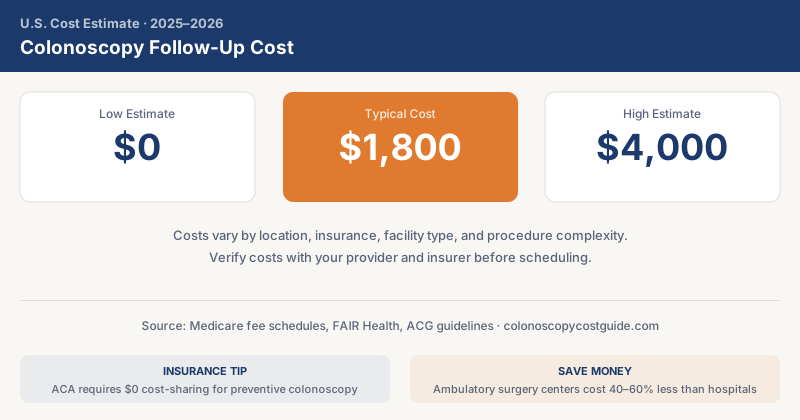
Colonoscopy Follow-Up Cost: Low, Intermediate, and High-Risk Surveillance Schedules
{ if eq .Lang "zh" }{ else }{ end }The colonoscopy you just had isn’t just a one-time event — it sets your surveillance schedule for the next decade. Here’s what each risk category costs you over time.
Your gastroenterologist’s post-procedure recommendation — “come back in 3 years” or “see you in 10 years” — has a significant financial consequence that most patients don’t think about in the exam room. The difference between a 10-year interval and a 3-year interval isn’t just clinical. It’s potentially $4,000 to $15,000 in cumulative out-of-pocket costs over the next decade.
The Post-Colonoscopy Risk Categories
The US Multi-Society Task Force on Colorectal Cancer (USMSTF) and the ACG published updated surveillance guidelines in 2020 that stratified patients into risk categories:
| Risk Category | Definition | Recommended Interval |
|---|---|---|
| No findings | No polyps, normal exam | 10 years |
| Low risk | 1–2 small (< 10mm) tubular adenomas | 7–10 years |
| Intermediate risk | 3–4 adenomas, OR any adenoma 10mm+, OR any villous/tubulovillous | 3 years |
| High risk | 5+ adenomas, OR any adenoma with high-grade dysplasia | 1 year |
| Serrated (low) | 1–2 small sessile serrated polyps, no dysplasia | 5 years |
| Serrated (high) | Large/dysplastic sessile serrated, or traditional serrated adenoma | 1 year |
10-Year Cost by Risk Category
These estimates assume a patient covered by commercial insurance with a $1,500 deductible, starting from their first screening colonoscopy at age 45.
Low-Risk Category (7–10 year interval)
| Year | Procedure | Estimated Patient Cost |
|---|---|---|
| Year 0 | Screening colonoscopy (preventive) | $0 – $200 (polypectomy may apply) |
| Year 7–10 | Surveillance colonoscopy (diagnostic billing) | $800 – $1,800 |
| 10-year total | $800 – $2,000 |
Intermediate-Risk Category (3-year interval)
| Year | Procedure | Estimated Patient Cost |
|---|---|---|
| Year 0 | Screening colonoscopy | $0 – $400 |
| Year 3 | Surveillance colonoscopy + pathology | $1,200 – $2,500 |
| Year 6 | Surveillance colonoscopy + pathology | $1,200 – $2,500 |
| Year 9 | Surveillance colonoscopy + pathology | $1,200 – $2,500 |
| 10-year total | $3,600 – $7,900 |
High-Risk Category (1-year interval)
| Year | Procedure | Estimated Patient Cost |
|---|---|---|
| Year 0 | Initial colonoscopy (with large polyps) | $400 – $1,200 |
| Years 1–5 | Surveillance annually | $1,000 – $2,000/year |
| Years 6–10 | May extend to 3-year interval if normal | $800 – $2,000 total |
| 10-year total | $6,000 – $14,000 |
Lifetime Surveillance Cost from Age 45 to 75
For a patient starting at age 45 and living to age 75, here’s the total colonoscopy surveillance cost by risk category:
| Risk Category | Estimated Lifetime Colonoscopies | Lifetime Out-of-Pocket (Insured) |
|---|---|---|
| No findings (10-year interval) | 3–4 | $0 – $600 (preventive billing) |
| Low risk (7-year interval) | 4–5 | $2,000 – $6,000 |
| Intermediate risk (3-year interval) | 9–11 | $9,000 – $22,000 |
| High risk (1-year intervals, then reduced) | 12–20 | $12,000 – $35,000 |
| IBD surveillance (annual) | 20–30 | $15,000 – $50,000 |
When Your Risk Category Can Improve
Medicare and Surveillance Colonoscopy Costs
For patients on Medicare, surveillance colonoscopy after polyp removal is a significant area of out-of-pocket exposure.
Medicare covers colonoscopy at $0 cost-sharing every 10 years for average-risk patients as a preventive benefit. For patients in surveillance — i.e., those who had polyps removed — Medicare covers diagnostic colonoscopy with standard Part B cost-sharing: 20% coinsurance after the Part B deductible.
However, since 2023, Medicare has been phasing in a provision that reduces cost-sharing for colonoscopies that begin as preventive screenings and become therapeutic during the procedure. By 2030, beneficiaries should pay no more than 20% of the coinsurance (i.e., 4% of the total Medicare-approved amount, not the full 20%). This is an ongoing policy change worth tracking.
For Medicare beneficiaries on Medigap Plan G, the out-of-pocket cost for surveillance colonoscopy is minimal: you pay the annual Part B deductible ($257 in 2025), then Medigap covers the 20% coinsurance. Over a lifetime of surveillance, this is dramatically cheaper than commercial insurance with recurring deductibles.
What Surveillance Colonoscopies Are Billed As
Most follow-up surveillance colonoscopies are billed as diagnostic procedures, not preventive. This is the most financially impactful classification you need to understand:
- Preventive: $0 under ACA-compliant plans, $0 under Medicare every 10 years for average risk
- Diagnostic: Deductible applies, coinsurance applies after deductible
When your doctor writes a referral for your 3-year follow-up colonoscopy, the billing code reflects “surveillance colonoscopy after prior polyp removal” — a diagnostic indication, not a primary screening. That means cost-sharing.
For patients who had polyps and want to understand the immediate cost impact in detail, see what happens if polyps are found. For patients with IBD-specific surveillance needs, see the Crohn’s disease colonoscopy cost and ulcerative colitis colonoscopy cost articles.
{ if eq .Lang "zh" }