Using HSA or FSA for Colonoscopy: What's Covered, How to Pay, and 2026 Limits
{ if eq .Lang "zh" }{ else }{ end }Your colonoscopy might be free under your insurance. But if it’s not — if it’s diagnostic, or you have an unmet deductible, or you owe coinsurance — your HSA or FSA turns that cost into pre-tax dollars. At the 22% federal tax bracket, that’s an automatic 22% discount on everything you pay.
Here’s exactly what’s eligible, how to use your accounts correctly, and what the 2026 limits let you stash away.
What Colonoscopy-Related Expenses Are HSA/FSA Eligible
The IRS defines eligible medical expenses broadly under Section 213(d) of the Internal Revenue Code. Every element of a colonoscopy encounter qualifies:
| Expense | HSA Eligible? | FSA Eligible? |
|---|---|---|
| Colonoscopy facility fee | Yes | Yes |
| Gastroenterologist fee | Yes | Yes |
| Anesthesia fee | Yes | Yes |
| Pathology / biopsy lab fee | Yes | Yes |
| Colonoscopy prep (Rx) | Yes | Yes |
| Colonoscopy prep (OTC Miralax) | Yes (post-CARES Act) | Yes (post-CARES Act) |
| Clear liquid diet foods | No | No |
| Transportation to/from procedure | Yes (mileage or actual cost) | Yes |
The CARES Act of 2020 permanently expanded HSA and FSA eligibility to over-the-counter medications without a prescription. That means your Miralax colonoscopy prep is HSA/FSA-eligible even without a prescription — as long as it’s purchased for medical purposes.
Transportation to and from your colonoscopy is also eligible — including mileage at the IRS medical mileage rate (21 cents per mile in 2024–2025; check IRS publication 502 for the current rate) or actual transit/rideshare costs if you can’t drive after sedation.
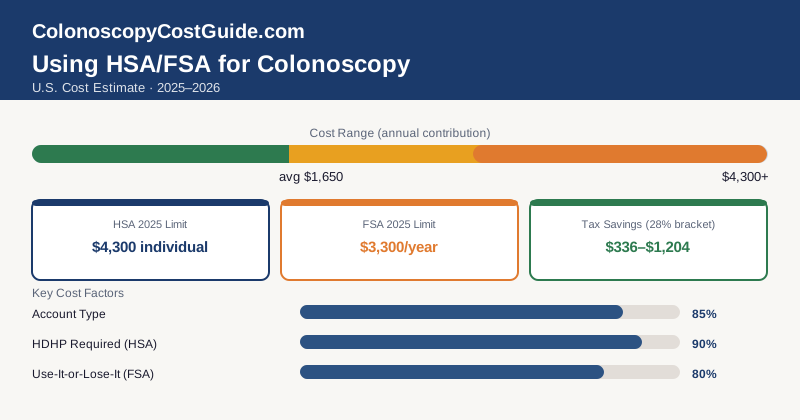
HSA 2026 Contribution Limits
HSAs require a qualifying High Deductible Health Plan (HDHP). For 2026, the IRS limits are:
| Coverage Type | 2026 HSA Contribution Limit |
|---|---|
| Individual (self-only) HDHP | $4,300 |
| Family HDHP | $8,550 |
| Catch-up contribution (age 55+) | Additional $1,000 |
Contributions are tax-deductible (or pre-tax if made through payroll), growth is tax-free, and withdrawals for qualified medical expenses are tax-free. Unlike FSAs, HSA funds roll over indefinitely — no “use it or lose it.”
The HSA strategy for colonoscopy: if your diagnostic colonoscopy costs $800 and you’re in the 22% federal bracket, paying from HSA means it cost you $624 in real dollars. For higher earners in the 32% bracket, that $800 colonoscopy costs $544. The savings are real.
FSA: How It Differs and What to Watch
A Flexible Spending Account is offered through employers and doesn’t require an HDHP. Key differences from HSAs:
- Contribution limit (2026): $3,300 per employee (IRS limit; employers can set it lower)
- Use-it-or-lose-it: Most FSA funds must be used by your plan year end (some plans offer a $660 rollover or 2.5-month grace period)
- Not portable: FSA funds are forfeited if you leave your employer (for most plan designs)
FSA colonoscopy strategy: if you know you’re scheduling a colonoscopy in the upcoming plan year, consider enrolling for the maximum FSA amount needed to cover expected out-of-pocket costs. FSAs are front-loaded — your full annual election is available on January 1 even if you haven’t contributed all of it yet. That means a January colonoscopy can be paid from a $2,000 FSA election even if you’ve only contributed $150 so far.
How to Pay for Your Colonoscopy With HSA or FSA
Option 1 — Pay at the facility with your HSA/FSA debit card: Use your account debit card directly for facility, physician, anesthesia, and lab bills when they arrive. This is the simplest approach.
Option 2 — Pay out of pocket, then reimburse yourself: Pay the bill with your regular bank account, save the Explanation of Benefits (EOB) as documentation, then request reimbursement from your HSA or FSA administrator. This allows you to wait until your deductible has been confirmed and apply costs in the correct order.
Option 3 (HSA only) — Pay later: HSAs have no deadline for reimbursement. You can pay today, keep the receipt, and reimburse yourself from your HSA years later — useful if you want to let your HSA grow invested in the meantime.
Documentation Requirements
The IRS requires that HSA and FSA withdrawals be for qualified medical expenses. Keep:
- Explanation of Benefits (EOB) from your insurer showing the expense
- Receipt or billing statement from each provider
- The date of service, provider name, and amount paid
You don’t submit these documents to the IRS — but you must keep them in case of an audit. Digital records are fine; take photos of paper EOBs and store in a folder or cloud account.
HDHP + HSA Strategy: Preventive vs. Diagnostic Colonoscopy
A common question: does a preventive screening colonoscopy cost you anything under an HDHP plan?
No. Under IRS rules, HDHPs are required to cover preventive services — including colonoscopy — at zero cost-sharing before the deductible is met, in line with ACA requirements. Your preventive screening colonoscopy costs $0 whether your deductible is $0 or $3,000.
If your colonoscopy is coded as diagnostic (you have symptoms, a positive stool test, or polyps are found and reclassified), it’s a non-preventive medical expense under your HDHP. Your deductible applies. That’s where HSA funds become especially valuable — see the colonoscopy cost with a high-deductible plan guide for specific dollar examples.
The bottom line on HSA/FSA for colonoscopy: every dollar of colonoscopy expense you pay through a pre-tax account is discounted by your marginal tax rate. There’s no faster legitimate discount in healthcare.
{ if eq .Lang "zh" }