Endoscopic Mucosal Resection (EMR) Cost: Polyp & Early Cancer Removal in 2026
{ if eq .Lang "zh" }{ else }{ end }A large flat polyp used to mean abdominal surgery, a hospital stay, and a five-figure bill. Today, a gastroenterologist can often peel that same lesion off your colon wall during a scope — endoscopic mucosal resection — for $2,500 to $9,000 without insurance, no incision required.
EMR lifts a lesion away from the deeper layers of the bowel wall (usually by injecting fluid underneath it first), then removes it with a snare or cap. It’s the go-to technique for large polyps and very early cancers that are too big for a simple snare but don’t yet warrant surgery. Here’s the cost picture.
What Endoscopic Mucosal Resection Costs
EMR is performed during a colonoscopy or upper endoscopy, so the base scope cost is the foundation, with the resection technique and pathology layered on top.
| Cost Component | Typical Range (Uninsured) |
|---|---|
| Base scope + facility fee | $1,500 – $4,500 |
| EMR technique / resection premium | $500 – $2,000 |
| Anesthesia / sedation | $500 – $1,500 |
| Pathology (per specimen) | $250 – $1,000 |
| Total estimate | $2,500 – $9,000 |
Compared with a routine colon polyp removal — where a small polyp is snared in seconds — EMR costs more because the lesion is larger, the technique is more involved, and more tissue goes to pathology.
Why EMR Costs More Than a Standard Polyp Snare
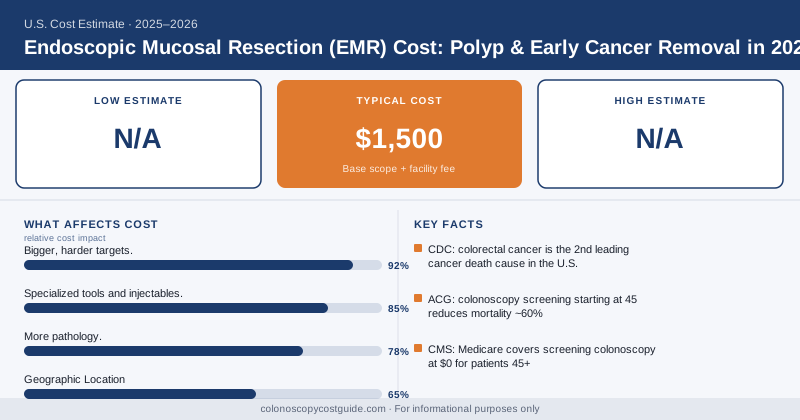
- Bigger, harder targets. EMR handles lesions a simple snare can’t safely remove, often piecemeal, which takes more scope time.
- Specialized tools and injectables. The lift solution, specialized snares, and clips for closing defects add supply costs.
- More pathology. Larger or piecemeal specimens mean more tissue blocks to process, and each adds to the lab bill.
The general facility and sedation drivers behind any scope-based procedure are covered in why is colonoscopy so expensive.
Why It’s Still a Bargain
Here’s the part that matters most for your wallet: EMR frequently replaces surgery. Removing a large colon polyp surgically can mean a colectomy — tens of thousands of dollars, a hospital stay, and weeks of recovery. EMR does it in an outpatient scope.
The American Society for Gastrointestinal Endoscopy (ASGE) considers EMR the preferred approach for most large, non-invasive colorectal lesions precisely because it spares patients surgery. And catching things early matters: the CDC reports that colorectal cancer remains a leading cause of cancer death in the U.S., and removing precancerous lesions before they progress is the whole point of screening.
Key Takeaway
Insurance Coverage
EMR is squarely medically necessary, so insurers and Medicare cover it. The catch is one that trips up screening patients constantly: if a lesion is found and resected during what started as a screening colonoscopy, the exam can be reclassified as diagnostic, shifting cost-sharing to you.
- Met deductible: your coinsurance on the facility and physician charges.
- Unmet deductible: the contracted rate up to your deductible.
How EMR Compares to Related Procedures
EMR sits on a spectrum. For small polyps, ordinary colon polyp removal during a colonoscopy is enough and cheaper. For larger or deeper lesions, EMR steps in. When a lesion needs to come out in one piece for accurate cancer staging, the more advanced endoscopic submucosal dissection is used — pricier and more specialized. To assess depth before resection, your doctor may use an endoscopic ultrasound, and any removed tissue gets evaluated like a standard endoscopy biopsy.
Bottom Line
Endoscopic mucosal resection costs $2,500–$9,000 uninsured, landing above a simple polyp snare but well below abdominal surgery for the same lesion. It’s the technique that lets doctors remove large polyps and early cancers without an incision, and insurance and Medicare cover it as medically necessary. Just be ready for the screening-to-diagnostic billing shift, confirm your anesthesia provider is in-network, and recognize the real win: EMR can save you a colectomy and the five-figure bill that comes with it.
{ if eq .Lang "zh" }