Screening vs. Diagnostic Colonoscopy Cost: The Billing Difference That Costs Hundreds
{ if eq .Lang "zh" }{ else }{ end }In 2010, this billing distinction barely mattered. Today, it can add $400 to a bill that should be $0 — and millions of Americans find out about it only when the EOB arrives weeks after their procedure.
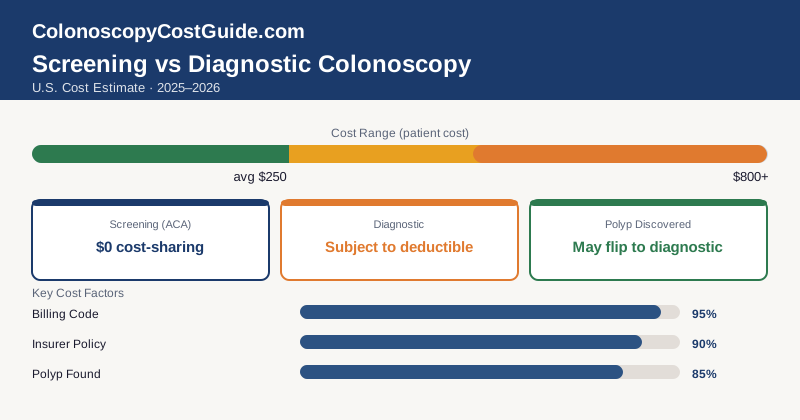
The rule is deceptively simple: a screening colonoscopy is a preventive service, covered at zero cost-sharing under the ACA. A diagnostic colonoscopy is a medical service, subject to your deductible and coinsurance. The problem is that a single polyp removal can legally convert a screening visit into a diagnostic one before you leave the recovery room.
What Makes a Colonoscopy “Screening”
A screening colonoscopy is performed on an asymptomatic, average-risk patient to look for cancer or precancerous polyps before symptoms appear. It’s purely preventive.
Billing codes used for screening colonoscopy:
- CPT G0121: Medicare’s specific screening colonoscopy code for average-risk patients
- CPT G0105: Medicare’s screening code for high-risk patients
- CPT 45378 with a Z-code diagnosis (Z12.11 — encounter for screening colonoscopy): used by many commercial insurers to indicate a preventive intent
Under the ACA’s Section 2713, health plans must cover USPSTF Grade A and B preventive services with no cost-sharing. Colorectal cancer screening has a Grade A rating. The USPSTF updated this recommendation in 2021 to start at age 45 for average-risk adults. That means zero cost-sharing, full stop — for a properly coded screening colonoscopy.
What Makes a Colonoscopy “Diagnostic”
A diagnostic colonoscopy is performed for a specific clinical reason:
- You have symptoms (rectal bleeding, changes in bowel habits, abdominal pain)
- You have a positive stool test (FIT, Cologuard) — this makes the follow-up colonoscopy diagnostic
- You have a personal history of colorectal cancer or polyps
- You have inflammatory bowel disease
- Your doctor finds and removes a polyp during what started as a screening exam
That last one is the loophole. The procedure code changes the moment a polyp is found and removed. CPT 45380 (biopsy) or 45385 (polypectomy) replaces or supplements CPT 45378. Many insurers interpret this as converting the entire encounter to diagnostic — triggering your deductible and coinsurance.
| Procedure Type | Typical Billing Code | ACA Preventive Coverage | Your Cost |
|---|---|---|---|
| Screening, no findings | CPT 45378 + Z12.11 | Yes | $0 |
| Screening with biopsy | CPT 45380 | Often reclassified | $150 – $800 |
| Screening with polypectomy | CPT 45385 | Often reclassified | $200 – $1,200 |
| Diagnostic (symptoms) | CPT 45378 + symptom code | No | Deductible + coinsurance |
| Follow-up after positive Cologuard | CPT 45378 + findings code | No | Deductible + coinsurance |
The ACA Loophole and the Congressional Fix
The USPSTF’s screening recommendation explicitly includes polypectomy as part of the screening service — you can’t screen without being able to remove what you find. The ACG (American College of Gastroenterology) and ASGE (American Society for Gastrointestinal Endoscopy) have argued for years that converting a screening to diagnostic when a polyp is removed contradicts the intent of the ACA mandate.
Congress agreed, partially. The Consolidated Appropriations Act of 2023 included a provision phasing in protections against the screening-to-diagnostic reclassification. Under that law:
- For plan years starting in 2023, cost-sharing for the therapeutic portion of a colonoscopy that starts as screening must be phased down
- By plan year 2025, cost-sharing for such procedures is reduced by 50%
- Full elimination of cost-sharing is set for 2025+ under some implementations, but enforcement varies by insurer
Some states have gone further and passed their own laws requiring zero cost-sharing even when polyps are removed. California, New York, and Illinois have state-level protections worth checking if you’re in those states.
The HR 1570 Status as of 2026
How Your Insurer Handles the Conversion
Every major insurer has a different policy. Some current positions:
- UnitedHealthcare: As of 2024, UHC covers polypectomy during a preventive colonoscopy at $0 cost-sharing for most commercial plans.
- Blue Cross Blue Shield: Varies by local affiliate. Many BCBS plans now apply $0 cost-sharing for the polyp removal portion; some still trigger cost-sharing on the therapeutic code.
- Aetna: Applies $0 cost-sharing to polypectomy during screening colonoscopy for ACA-compliant plans.
- Cigna: Similar to Aetna — generally $0 for polyp removal during screening.
These policies can change. Verify your specific plan year before scheduling.
What To Do Before Your Procedure
Don’t assume. Ask. These are the two questions that prevent surprise bills:
- Call your insurer: “If my doctor removes a polyp during my screening colonoscopy, will you apply cost-sharing or treat the entire procedure as preventive?”
- Ask your GI office: “How will you code my procedure? If you find a polyp, will you bill CPT 45380 or 45385 separately, and does your billing department know our insurer’s current policy?”
Get the answer from your insurer in writing if possible — through their member portal message system creates a record. If they give you a verbal confirmation, document the date, representative name, and call reference number.
The Bottom Line
The billing code on your colonoscopy claim determines whether you pay nothing or pay hundreds. For a routine screening with no polyps found, you should pay $0 under any ACA-compliant plan. The moment a polyp is removed, your insurer may apply cost-sharing — but that’s increasingly illegal under federal and state law. Know your insurer’s current position before you go in.
{ if eq .Lang "zh" }